Merge Age: Stone Haven
- 4.7
- Rating
- 1.00M
- Installs
- Free
- Price

 Analysis by App-foxy
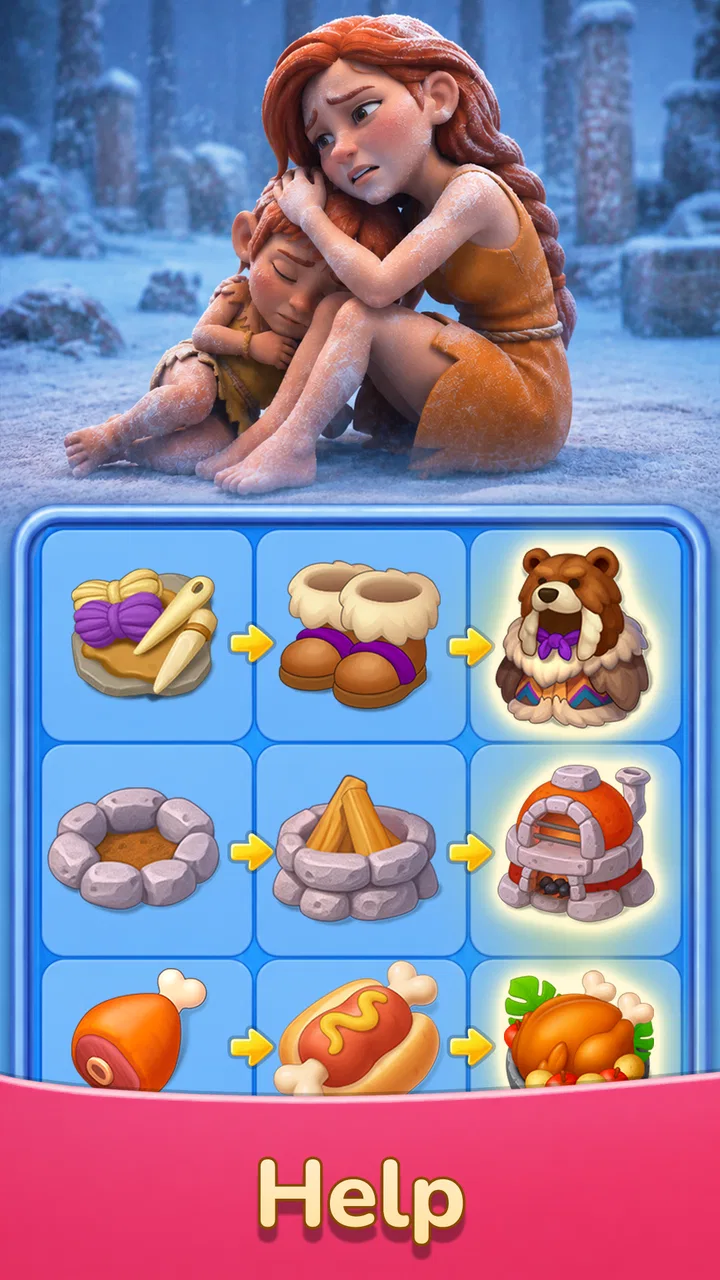
Merge Age: Stone Haven is a puzzle game from Puzzle1Studio built around a simple idea: combine matching pieces and use the results to develop a village. I found the basic concept easy to understand within moments, but the appeal comes from how a small merge can feed into a wider building goal. It is the kind of game I can open for a short break, make a few decisions, and close without needing to learn a complicated control scheme.
That simplicity also makes the game approachable for people who do not usually play puzzle titles. There is no need to master fast reactions or remember a large set of controls. The main challenge is deciding what to combine now and what to keep for later. In my experience, that gives the game a calmer feel than match-three puzzles, while the village theme gives each move a sense of direction beyond merely clearing a board.
How the village-building puzzle loop feels
I find the village-building loop most enjoyable when I treat the board as a small planning problem rather than a race to merge every matching piece. In this section, I’ll focus on how that pace affects the feel of a session—and why a few deliberate choices can matter more than tapping quickly.
You May Also Like

 Blood Strike: 2.5 Anniversary
Blood Strike’s Loadouts Turn Every Drop Into a Tactical Gamble
A close look at Blood Strike’s custom loadouts: how fast access to signature weapons reshapes its battle royale rhythm, rewards preparation, and narrows the gap between fights.

 Pandora - Music & Podcasts
Pandora’s Music Is Easy to Start, but Harder to Recover
Pandora’s strength is its low-effort path from a seed to a station. Its weak spot is how much confidence it asks you to place in connection, setup, and quiet recovery.

 8 Ball Pool
 Is Built on Rivalries, Rematches, and Routine
A close look at the rivalries, rematches, shared routines, and unanswered safety questions that turn a quick pool match into a persistent mobile community.

 Samsung Music
’s Quiet Strength Is Playing What You Already Own
Its reach comes less from spectacle than from dependable access to a personal library. That simplicity is both the app’s strongest retention engine and its ceiling.

 AccuWeather: Weather Radar
AccuWeather Review: A Quick, Clear Forecast for Everyday Decisions
For everyday plans, the best forecast is the one you can understand quickly. AccuWeather makes rain timing, radar, and local conditions easy to act on, with a few trade-offs.

 Hill Climb Racing
Why Hill Climb Racing Still Turns Crashes Into One More Run
A tiny car, a bumpy hill and one more upgrade: Hill Climb Racing keeps resurfacing because its simple chaos makes every near-miss feel personal.
More From Our News Desk



Simple merging with a longer-term purpose
The central loop is easy to describe: merge pieces to create progress, then use that progress to build up your village. What makes this more interesting than a basic matching exercise is the need to think about space and timing. A merge may solve an immediate problem, but it can also remove useful pieces from the board or leave awkward gaps for the next move.
I recommend treating every available merge as a choice rather than an automatic action. When the board is becoming crowded, it is tempting to combine anything that matches. That can be useful for clearing room, but saving a pair for a larger chain may produce better results. The most satisfying moments come from preparing several moves ahead instead of tapping through every possible combination as quickly as possible.
This is also where the village layer matters. The building goal gives the puzzle activity a visible reason to continue. If you enjoy watching a setting develop gradually, the structure is more motivating than a puzzle game that only offers an endless score. On the other hand, anyone looking for a deep city-management simulation should adjust expectations. The focus is still on merging, not on detailed economic planning or complex construction management.
A useful game for short sessions
I can imagine using this game during a commute, while waiting for an appointment, or at the end of the day when I want something interactive but not demanding. The controls are well suited to one-handed play, and the basic objective is clear enough that I do not need a long warm-up after leaving it alone for a while.
There is a practical rhythm to short sessions. I usually begin by checking the board, identifying the most valuable available combinations, and deciding whether the priority is clearing space or advancing the village. That small pause is worthwhile. Rushing tends to create a messy board, while a few seconds of planning can keep several options open.
The game is less suitable for someone who wants constant novelty every few minutes. Merge puzzles often rely on repetition, and this one asks the player to perform related actions many times. The village setting helps, but it does not completely remove the familiar cycle of collecting, combining, and upgrading. If you need fast action, competitive matches, or a story that drives every session, another puzzle category may suit you better.
Progress feels best when you manage space carefully
One of the less obvious skills is learning to value open space. A crowded board can make the game feel harder even when useful pieces are present, because new items have fewer places to go. I found it more effective to plan around the largest clusters first and avoid filling every available position with low-value pieces unless that move creates a clear chain.
Another helpful habit is to separate short-term and long-term decisions. Clearing a low-level pair may make the board look tidier, but it may not be the best route toward a stronger merge. Before tapping, I ask whether the move creates room, completes a useful sequence, or supports the next village objective. If it does none of those things, waiting can be the smarter choice.
This approach makes the game more thoughtful without turning it into a stressful puzzle. It also gives experienced players something to improve beyond simply playing for longer. The real advantage comes from reducing wasted moves and recognizing which pieces are worth protecting.
Fairness and the role of spending
Merge Age: Stone Haven is free to download and play, with optional in-app purchases ranging from $0.99 to $99.99 per item. That wide range is important for anyone deciding how to approach the game. I would begin with a no-spend trial and watch how comfortable the normal progress feels before considering any purchase.
From a fairness perspective, the key question is whether spending feels like a convenience or a requirement. My advice is to judge that through your own play pattern: if you can make progress by planning merges and returning when you have time, the free route may be enough. If the game repeatedly pushes you toward buying simply to continue at a reasonable pace, that changes the value calculation considerably.
I would not treat the existence of purchases as proof that the game is unfair. The confirmed purchase range tells me that optional spending is part of the product, but it does not by itself establish how often offers appear, how much they accelerate progress, or whether every feature remains comfortable without paying. Those are practical questions to evaluate while playing rather than assumptions to make in advance.
For families, the Everyone age rating makes the game broadly accessible from a content standpoint. Still, the purchase range means I would use the device’s purchase controls if a child might play unattended. That is not a criticism unique to this title; it is simply sensible whenever a free game includes optional payments.
Does it feel competitive?
This is not the sort of puzzle game I would choose for head-to-head competition. Its main appeal is personal progression through merging and village development, so the fairness question is less about leaderboard advantage and more about whether paid options distort the individual journey. Players who enjoy comparing scores or competing in real time may find the experience too solitary.
That can be a strength for people who want a low-pressure game. There is no need to match another player’s speed or keep up with a live opponent. I can play at my own pace and stop when I have had enough. The trade-off is that motivation depends heavily on enjoying the merge-and-build loop itself.
Compared with a traditional match-three game, this has a slower, more deliberate feel and a stronger sense of accumulation. Compared with a pure merge game, the village gives the results more context. Compared with a full strategy game, it is much lighter and easier to pick up. I think that middle position is its clearest identity, but it also means it may not satisfy players who want either intense puzzle pressure or deep planning systems.
What I would check before spending
I would pay attention to three things during the first several sessions. First, notice whether the board gives enough room to make meaningful choices without constantly forcing a purchase. Second, see whether the village continues to provide a clear reason to merge or starts feeling like a decorative layer. Third, check whether your enjoyment comes from solving the board or from chasing the next reward.
This simple test helps separate genuine interest from impatience. If I am considering a purchase only because I made a poor sequence of merges, I would rather restart my approach and improve my planning. If I am still enjoying the game after playing carefully and the purchase would merely save time, then the decision becomes a personal convenience choice rather than a necessity.
I would also avoid buying simply because an offer looks urgent. A calm game should not turn into a rushed spending decision. Since individual item prices can reach $99.99, setting a personal limit before playing is a sensible safeguard. The game can be enjoyable without treating every offer as part of the core puzzle.
What remains important to evaluate personally
There are several parts of the experience I would not pretend to settle from the basic store details alone. The long-term balance between free progress and paid assistance is something each player should observe. So is the frequency of purchase prompts and the way the game handles moments when the board becomes difficult to manage.
That uncertainty does not make the game impossible to recommend, but it does affect how I would approach it. I would install it as a free puzzle game first, not as a commitment to buy anything. After a few sessions, I would know whether the village goals genuinely keep me interested and whether the available pace feels fair for the way I like to play.
I would also ask myself whether I enjoy gradual progress more than immediate variety. Merge games can be relaxing precisely because their rules stay familiar, but that same consistency can feel repetitive. If you prefer puzzles that constantly introduce new mechanics, a more level-based title may be a better choice. If you like improving a board through patient decisions, this format is more promising.
Technical fit and who should try it
The game supports devices running Android 6.0 or later, so it is available to a broad range of Android users. Puzzle1Studio is the developer, and the current version is 2631.1.0. The title has passed the million-install mark and holds a 4.7 average from around 7.6 thousand ratings, which suggests that the basic concept has attracted a substantial audience.
I would recommend it most strongly to players who enjoy relaxed puzzle sessions, gradual visual development, and decisions that reward patience. It is also a good fit for someone who wants a game that can be played in small pieces rather than requiring a long uninterrupted session. The Everyone rating makes it an approachable option for a wide audience, although younger players should not have unrestricted access to purchases.
I would skip it if your ideal puzzle game is built around speed, precision, or direct competition. I would also be cautious if you dislike free-to-play structures with optional purchases, even when you plan not to spend. The presence of items priced up to $99.99 may be enough to make another paid puzzle game feel more comfortable and predictable.
My practical verdict
After looking at the whole experience, I see Merge Age: Stone Haven as a pleasant, accessible merge puzzle with a clear village-building purpose. Its best quality is the way it turns small board decisions into visible progress. I like that I can play slowly, make a plan, and return later without needing to chase a competitive result.
Its main limitation is equally clear: the core activity remains repetitive, and the free-to-play purchase structure deserves attention. I would not spend immediately. I would first learn how much progress I can make through careful merging, decide whether the village goals keep me engaged, and only then consider whether an optional purchase adds enough convenience to be worthwhile.
For me, the strongest recommendation is for a friend who wants a calm puzzle game rather than a demanding strategy challenge. The smartest way to play is to protect board space, plan chains before tapping, and treat spending as optional convenience rather than part of the solution. If that sounds like your style, Merge Age: Stone Haven is worth trying for free. If you need intense competition, constant mechanical change, or a completely purchase-free experience, I would choose a different puzzle game instead.
FAQs for Merge Age: Stone Haven
01What is Merge Age: Stone Haven about?
Merge Age: Stone Haven is a casual merge-and-building game set in a prehistoric world. You combine matching items to create upgraded materials, complete tasks, expand your settlement, and unlock new areas. The game mixes simple puzzle mechanics with light resource management and progression, making it suitable for players who enjoy relaxed gameplay, exploration, and gradually developing a small Stone Age community.
02How does the merging system work in Merge Age: Stone Haven?
The main gameplay involves dragging three or more identical objects together to merge them into a more advanced item. These upgraded materials can be used to complete orders, repair structures, produce resources, and progress through the story. Planning is important because the board has limited space, so merging efficiently and avoiding unnecessary clutter can make objectives easier to complete.
03Can Merge Age: Stone Haven be played without spending money?
Yes, Merge Age: Stone Haven can generally be played for free, and the core merging and settlement-building experience is available without making a purchase. However, optional in-app purchases may provide extra energy, boosters, premium currency, or faster progress. Players who prefer not to spend should expect energy limits, waiting periods, and a slower pace when completing repeated tasks.
04Does Merge Age: Stone Haven require an internet connection?
An internet connection may be needed for certain features, such as loading events, synchronizing progress, displaying advertisements, processing purchases, or accessing online content. Some basic gameplay may work temporarily while offline, but availability can depend on the device and current version of the app. For the most reliable experience, it is recommended to launch and play the game with a stable connection.
05Is Merge Age: Stone Haven suitable for children and casual players?
Merge Age: Stone Haven is designed around accessible drag-and-drop mechanics, colorful visuals, and straightforward objectives, so it can be approachable for casual players. Nevertheless, parents should review the store rating, advertising practices, and in-app purchase settings before allowing children to play. Progress systems and timed rewards can also encourage frequent play, so parental controls may be useful.
Pros
- Relaxing merge gameplay that is easy to learn and play at your own pace.
- A charming prehistoric setting gives the island a distinctive visual identity.
- Short tasks make it suitable for quick sessions during breaks.
- Progression gradually unlocks new areas
- resources
- and crafting possibilities.
- The game offers satisfying collection goals for players who enjoy completing sets.
Cons
- Energy limits can interrupt longer play sessions.
- Some upgrades and discoveries require considerable waiting time.
- The merge board may become crowded when several tasks are active.
- Later progression can feel repetitive without major gameplay changes.
- Optional purchases may appeal to players who want faster progress.

Merge Age: Stone Haven
Gallery